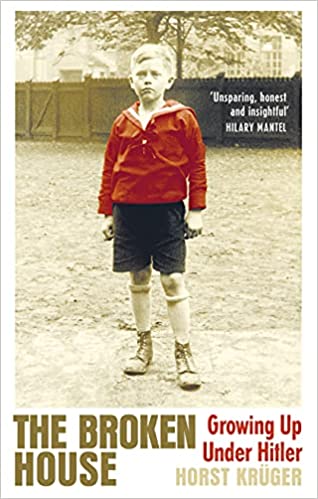
Horst Krüger was one of the tens of millions of Germans who, without being affiliated to the Nazi party, lived under the belief that Hitler was a God-sent blessing to their country. Born in 1919, he published The Broken House – Growing Up Under Hitler in 1966, causing considerable impact in a West Germany eager to enjoy economic prosperity and democracy, and not at all interested in examining its collective responsibility in the horrors of the past.In his book, Krüger describes the frame of mind that prevailed in the ‘apolitical’ suburbs of Berlin where he lived with his emotionally distant parents and his sister Ursula –whose suicide, in 1938, he sees as a liberation from the constraints of a petty-bourgeois, mediocre milieu. Death as freedom: this feeling, not easy to confess, was perhaps present in the fascination that hitlerist warmongering and anti-Semitic hatred exerted in so many Germans.
However, Krüger does not try to offer any interpretations of the whole phenomenon. With visible uneasiness –something that gives a somewhat sluggish pace to this relatively concise book—he focuses on what he thought and felt (or, rather, didn’t think and didn’t feel) during all those years. One senses that he had painful labour digging into his past, and also that he was not disposed to dig deep enough.
It is therefore doubtful that his memoir, now translated into English, will cause much stir in a readership already acquainted to a large mass of better (and more shocking) books about the behaviour of ‘normal’ people in Nazi Germany.
Whoever has read, for instance, Daniel Goldhagen’s Hitler’s Willing Executioners –a detailed account of the atrocities perpetrated against Jews by ordinary soldiers—will find Krüger’s recollections disquietingly hazy and reticent.
There is no reason to suppose that, during his years in the Wehrmacht, the author had himself any participation in crimes against humanity. But has he nothing to say about the behaviour of his commanders in Vitebsk, Orel or Smolensk, where he spent the winter of 1943? ‘I am only a corporal driving a truck, an Opel Blitz’, he recalls; ‘I am driving a platoon of paratroopers to the front, to a front that is supposed to protect not only Berlin, but also Auschwitz. I´m from Berlin, twenty-two years old. I’ve never heard the name of Auschwitz.’
Beneath those short, present-tense sentences, something like a repressed pang of guilt seems to beat in a steady rhythm. Not guilt for having participated in some massacre, but the paradoxical guilt of someone who remained innocent while atrocities happened around him.
At the same time, it is difficult to avoid the impression that he is still silencing the most brutal aspects of his war experiences. Had he never met fanatical SS officers during all those years? Had he never seen examples of truculence and injustice while serving in the regular army? More disturbingly, perhaps, one can ask if he considered that occasional bursts of authoritarianism and cruelty were too normal to merit any register.
Even when Krüger is near to Nazi evil in its purest form, his recollections adopt a tone of mechanical neutrality. Between December 1939 and April 1940, before being detailed to the Wehrmacht, he was interrogated by the Gestapo. No, he was not tortured; but he could hear the cries of other prisoners during his months of detention. He communicated with them; he saw the grinning faces of the torturers. He was finally released. The charges against him were not serious: he had only delivered secret messages to members of an anti-Nazi organization, to which he was loosely connected.
Krüger does meet, however, a prisoner who had been beaten up by the Gestapo in another unit. His name is Siegfried Levi, and he is thrown into the cell Krüger shares with other prisoners. ‘I see the little man stumble in, see him stand fearful and helpless by the wooden bunks and hear him asking in a polite voice: “Where may I sit, gentlemen?” Silence, laughter, snorting in the room—have they heard anything like this before? Gentlemen?’
Then ‘the little bald man, who had previously owned a jewellery shop’ (another sign, of course, of Jewishness to Krüger) ‘burst into loud childish wails’. Krüger gives him some bread. ‘He sobbed and groaned away: “now they’re going to come and beat me again, you can’t eat out of turn, sir, don’t you know that?”’. The paragraph ends appallingly: ‘It was ridiculous: he was very funny, the strange Herr Levi. In spite of everything, he often made us laugh.’
Since Primo Levi’s classical accounts of life in concentration camps, it has been usual to avoid any sentimentality when writing about the Shoah. In passages like this, Krüger seems to do more (or less) than that. His recollection of Siegfried Levi’s desperate humour does not seem purely unsentimental: sticking, as always, in the present tense, Krüger is somewhat mimicking the insensitivity and moral blindness of his earlier self.
One might ask how far he was, in the moment of writing his book, from this state of mind. In 1964, as a journalist, he watched the so-called Auschwitz trial in Frankfurt’s council city hall. Ancient Nazi criminals were being brought to justice in the aftermath of the 1961 Eichmann trial in Israel. Krüger is surprised to see that the twenty-two defendants were ‘indistinguishable from the rest of us’. ‘They behave like everyone else, they are well-fed, well-dressed gentlemen advanced in years: academics, doctors, businessmen, craftsmen, caretakers, citizens of our affluent new German society.
After Hannah Arendt’s reflections on the ‘banality of evil’ (published in the New Yorker magazine one year before), Krüger’s thoughts here –in what consists the last chapter of his book—do not strike as particularly original. The problem with them, however, is not simply that of a lack of originality. Once again, The Broken House reveals a strange sort of unwilling ethical numbness towards the picture it describes. A foreign visitor, or someone who, like Hannah Arendt, left Germany in 1933, would naturally feel bewildered by the ‘normality of those criminals. But Krüger lived in Germany all that time; is it possible that he had never asked himself about what had become of all the SS henchmen, Gestapo torturers and hysterical Nazis he knew for so many years?
In perhaps the most shocking sentence of his book, Krüger writes: ‘And now for the first time” (that is, in 1964) ‘I understand why there are Jews who won’t come back to this second German republic, even though it’s become decent and tolerable again. Fear, very private fear: the tram driver, the person behind the counter at the post office or the station, the chemist or indeed this capable nurse from West Berlin –of course, it could be any of them’. In other words, during the twenty years that had elapsed since the defeat of Nazism, Krüger couldn’t understand why the surviving Jews were unwilling to return to Germany…
The Broken House may have had a role in awakening the moral conscience of German people in 1966; today, its glassy-eyed, sleep-walking present tense prose gives the disquieting impression that Krüger himself was slow to recover from the moral lethargy into which Germany was immersed for so long.
Horst Krüger, The Broken House. Growing Up Under Hitler. Translated by Shaun Whiteside. The Bodley Head, London. 192 pages.
 Tastes and Distastes